
How Visceral Fat Compromises Your Metabolic Health
We’ve known since around the 1940s that where the body stores fat matters more than just how much a person weighs.
Over the decades, research has helped us understand why abdominal and visceral fat matter. In particular their relationship with insulin resistance, inflammation, blood lipids, liver function, and cardiovascular risk.
So, after nearly 80 years of research, perhaps the question isn’t simply, “How much do I weigh?” but rather, “What is happening metabolically inside my body?”
What has changed is our understanding of why visceral fat can be so metabolically disruptive. That is what I want to explore in this article: how excess visceral fat can compromise metabolic health and why the number on the scale doesn’t tell the whole story.
What Is Metabolic Health?
Metabolic health describes how well your body processes, uses, stores, and regulates energy and nutrients.
When we eat, the body has to decide what to do with the nutrients coming in. Glucose needs to be regulated, insulin needs to respond appropriately, fats need to be processed and transported, and the liver and other tissues help coordinate how energy is used and stored.
Good metabolic health generally looks like this:
Blood glucose regulation - Can the body keep blood sugar within a healthy range?
Insulin sensitivity - Are cells responding appropriately to insulin?
Blood lipids - How are triglycerides, HDL, LDL and other lipoproteins being managed?
Blood pressure - Is the cardiovascular system maintaining healthy pressure?
Waist circumference/fat distribution - Where is excess energy being stored? Around the abdomen?
You can think of metabolic health like this. Metabolism is the collection of chemical processes occurring in the body that sustain life. Metabolic health describes how well many of those energy-regulating processes are functioning.
Where Does Visceral Fat Live in the Body?
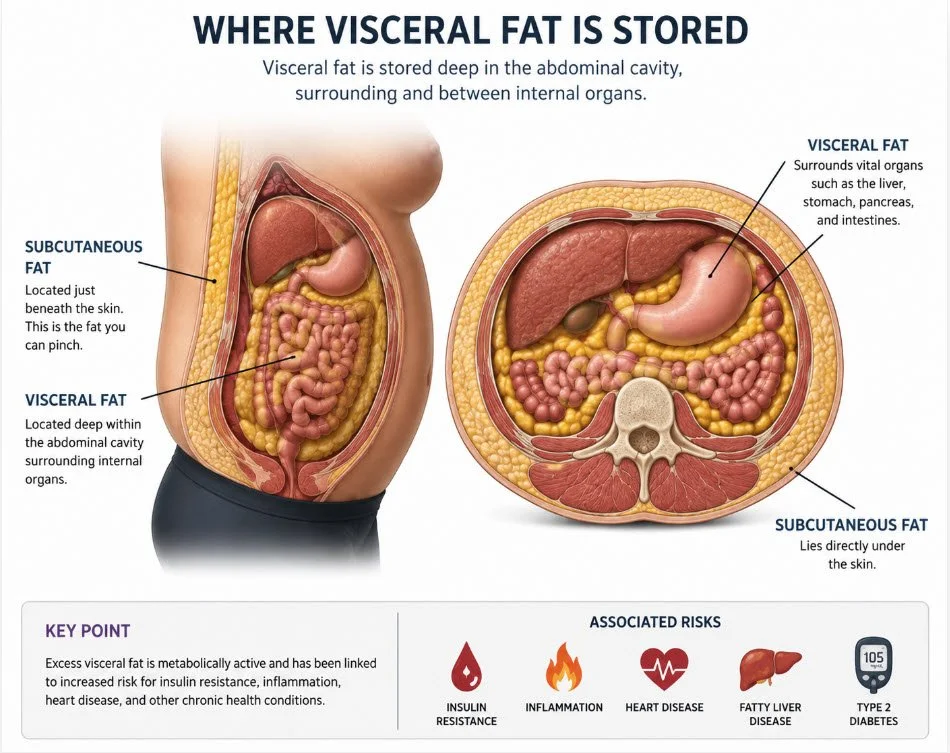
Unlike fat stored directly beneath the skin, visceral fat is stored deep within the abdominal cavity as shown in the picture below. When too much accumulates, it can begin interfering with many of the processes that help maintain metabolic health.
How Does Visceral Fat Accumulate in the Body?
Visceral fat accumulation isn't caused by one food or one behavior. It develops through an interaction between energy balance, food choices, physical activity, sleep, stress, hormones, genetics, and aging. This is how it is accumulated:
Consistently consuming more energy than the body needs: Excess energy can be stored as body fat. Where that fat is stored varies among individuals, but chronic energy surplus can contribute to visceral fat accumulation.
Food quality and eating patterns: Diets high in highly processed foods, refined carbohydrates, added sugars, and excess saturated fat—especially when they contribute to excess calorie intake—are associated with poorer metabolic health and greater abdominal fat accumulation. You don't want to imply that one particular food "creates visceral fat."
Low physical activity: Muscle is a major site for glucose disposal. Regular movement and resistance training help improve insulin sensitivity and energy utilization. A sedentary lifestyle removes some of that metabolic demand.
Chronic stress: Stress hormones such as cortisol influence appetite, glucose metabolism, and fat distribution. Persistently elevated stress can be one contributor to greater abdominal fat accumulation.
Poor or insufficient sleep: Inadequate sleep can affect insulin sensitivity, hunger and satiety signaling, food choices, and energy regulation—all of which can make visceral fat accumulation more likely over time.
Hormonal changes and aging: As we age, body composition and fat distribution can change. This is especially relevant during menopause, when declining estrogen is associated with a shift toward greater abdominal and visceral fat storage.
Loss of muscle: With less metabolically active muscle tissue, energy expenditure and glucose disposal can decline. Maintaining muscle becomes increasingly important with age.
Visceral fat doesn't usually accumulate because of one bad choice. It reflects what has been happening in the body's metabolic environment over time.
What is Visceral Fat Doing in the Body?
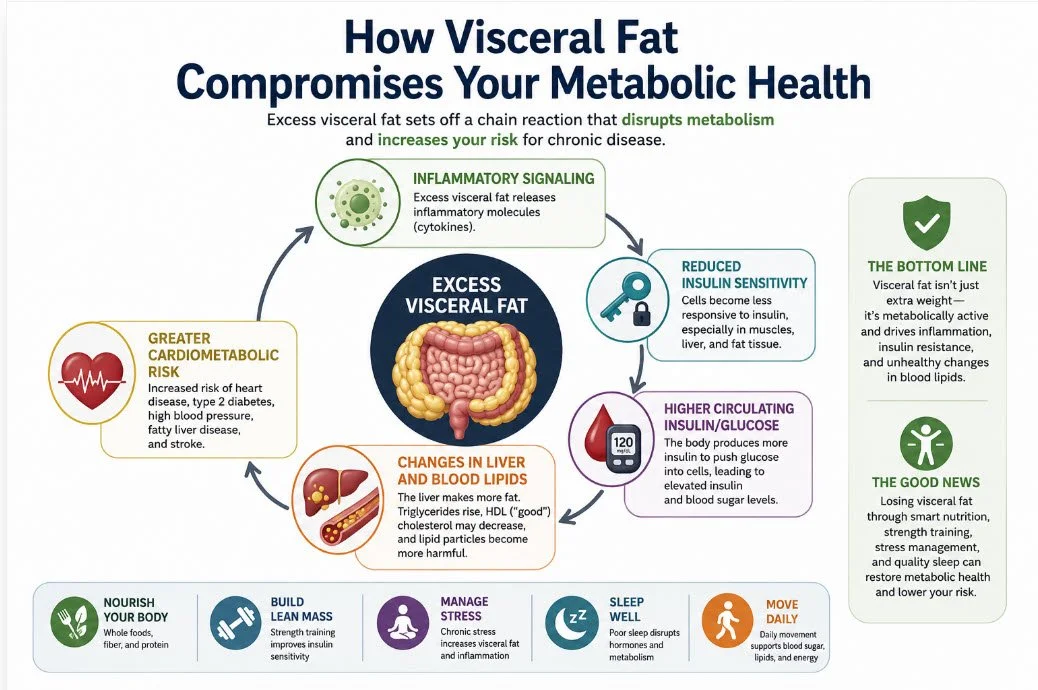
Now that we understand some of the conditions that promote visceral fat accumulation, what happens when too much of it is present? The visual representation below depicts what is happening in the body when we carry to much visceral fat.
HOW TO REDUCE VISCERAL FAT?
The good news is that visceral fat is responsive to lifestyle changes. Reducing visceral fat isn't about finding one perfect food, eliminating an entire food group, or doing endless abdominal exercises. It is about consistently creating an environment that supports better metabolic health.
Start with the fundamentals:
Build your meals around whole, nutrient-dense foods. Prioritize quality protein, vegetables, fruits, fiber-rich carbohydrates, and healthy fats while reducing highly processed foods and excess added sugars.
Build and maintain muscle. Resistance training helps preserve and build lean muscle while supporting insulin sensitivity and glucose regulation.
Move throughout the day. Walking, cardiovascular exercise, and simply spending less time sitting all contribute to better metabolic health.
Prioritize sleep and manage stress. Both influence appetite, insulin sensitivity, recovery, food choices, and the hormonal environment involved in fat storage.
Focus on consistency. Visceral fat accumulates over time, and reducing it also takes time. Small behaviors practiced consistently can create meaningful changes in metabolic health.
Remember, the goal isn't simply to change the number on the scale. The goal is to improve what is happening inside your body.
READY TO START REBUILDING YOUR HEALTH?
Understanding what's happening inside your body is the first step. Knowing what to do next and how to make those changes sustainable is where the rebuilding begins.
If you're ready to take a closer look at your nutrition and lifestyle and learn how to create habits that support your metabolic health, schedule a 15-minute consultation with me to talk about where you are today and where you want to go.
References:
Tchernof A, Després JP. Pathophysiology of Human Visceral Obesity: An Update. Physiol Rev. 2013 Jan ;93(1):359-404. doi: 10.1152/physrev.00033.2011.
Janochova K, Haluzik M, Buzga M. Visceral fat and insulin resistance - what we know? Biomed Pap Med Fac Univ Palacky Olomouc Czech Repub. 2019 Feb;163(1):19-27. doi: 10.5507/bp.2018.062. Epub 2018 Nov 6. PMID: 30398218.
Item F, Konrad D. Visceral fat and metabolic inflammation: the portal theory revisited. Obes Rev. 2012 Dec;13 Suppl 2:30-9. doi: 10.1111/j.1467-789X.2012.01035.x. PMID: 23107257.